The ICC World Twenty20 2009 will be the second time a world event for Twenty20 cricket has been held.
The event, which feature 12 teams in the men's tournament and eight teams in the women's competition, will be staged in June 2009 at Lord's, The Oval, Trent Bridge and Taunton.
The inaugural ICC World Twenty20 competition took place in South Africa in September 2007.
The competition, which lasted for just two weeks, was a thrilling event which culminated in India's dramatic five run defeat of Pakistan at Johannesburg.

Your Ad Here

Ishant Sharma and Mahela Jayawardene pose with the ICC World Twenty20 trophy

The ICC World Twenty20 trophy on display in a Colombo shopping centre
Steve Elworthy during an ICC World Twenty20 press conference at Lord's
Brad Haddin and Younis Khan with the ICC World Twenty20 trophy

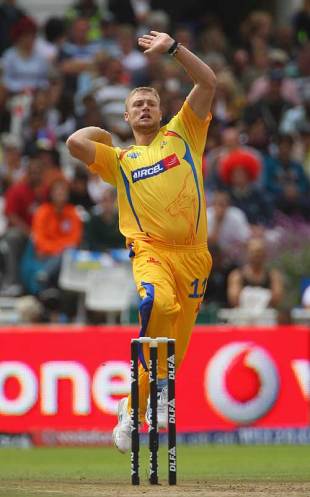
England could be forced to go into next month's ICC World Twenty20 without the services of their premier allrounder, Andrew Flintoff, after he revealed that he has yet to start running after undergoing surgery on a knee injury sustained during his brief stint at the IPL in April.

Flintoff was one of 15 players named in England's squad for the tournament, which starts at Lord's on June 5. But England could have to name a replacement if he cannot prove his fitness in the next three weeks. "I'd love to play in the Twenty20," he told Sky Sports, "but that might be too tight."

With the Ashes fast approaching in July, England desperately need Flintoff, 31, to be fully fit and firing before the arrival of the Australians. But despite his history of injury problems, which include a hip complaint that caused him to fly home midway through the tour of the Caribbean in March, he remains confident about recovering in time.

"I had an operation two weeks ago and I'm already off my crutches," he said. "The Ashes are a long way off - and I'll be fine for them."

England's Twenty20 captain, Paul Collingwood, conceded that the loss of Flintoff for the tournament would be a "huge blow", but felt sure that they would be able to make do without him.

"He's very much two players in one - as I've always said," said Collingwood. "But I think we've got quite a versatile squad with the players we've got in there. It would be a huge blow if he wasn't going to be fit, but we certainly have the players in the squad to overcome that in many ways."

Collingwood even raised the prospect of leaving Flintoff's place in the squad open for a late return, if he was able to recover in time. "Without Fred, it makes it very difficult to get the right balance between batters and bowlers in the final 11," he said Collingwood. "It's something we're going to have to gauge."

The Pakistan Cricket Board is seriously considering withdrawing the offspinner Saeed Ajmal from the ICC World Twenty20 squad as they await the results of the tests done on his bowling action.

Ajmal's doosra was reported by the umpires during the second one-day international against Australia in Dubai last month but was allowed to continue bowling till an assessment of his action, done by the ICC's appointed biomechanist Bruce Elliott, is completed.

"Elliot is supposed to send a report based on the tests to the ICC in 14-days time maximum but he can do it earlier," Saleem Altaf, the PCB's chief operating officer, told Dawn. "So we are waiting to see what happens. But we are also pondering the possibility of pulling him out of the [Twenty20] World Championship and including a reserve player."

Ajmal and Shahid Afridi are the only two recognised spinners in the World Twenty20 squad.

Meanwhile, the PCB has asked Pakistan coach Intikhab Alam to submit the medical report on Shoaib Akhtar's skin infection, which forced the fast bowler to skip the high-altitude conditioning camp at a mountain resort in Bhurban. He was adviced at least 7-10 days of rest.

"We want to have a look at the medical report because players are supposed to attend the conditioning camp which is primarily meant to check their fitness and endurance levels ahead of the World Twenty20 Championship," Altaf said.

Shoaib was included in the squad despite a long history of breakdowns and fitness problems.

Shoaib Akhtar's latest fitness concern, a skin problem, has ruled him out of Pakistan's training camp for the World Twenty20, coach Intikhab Alam said.

"The doctors have advised Shoaib Akhtar at least 7-10 days of rest and he will not be the part of the training camp," Alam told AP from Bhurban. Pakistan's six-day training camp, to be held at a mountain resort, will begin on Thursday.

The World Twenty starts on June 5, and Alam was hopeful Shoaib would be available for the tournament, where Pakistan are in Group B along with the Netherlands and host England. "I hope he will be fully fit before the all-important event," he said.

A host of injury problems have combined to restrict Shoaib's appearances at the international level over the past six months. He missed the one-dayers against West Indies in Abu Dhabi last October due to a calf injury, while a knee problem ruled him out of the Tests against Sri Lanka earlier this year.

Shoaib did play the entire limited-overs series against Australia in the UAE over the past month, but he was nowhere near his best, taking three wickets at 50.66.

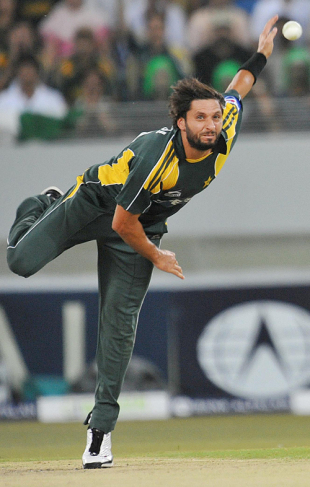
Shahid Afridi believes Pakistan's recent lack of international cricket will not hamper their chances at the World Twenty20 in England next month. Since January 2007, no team has played as little as Pakistan's ten Tests and 50 ODIs. Even Bangladesh, the weakest Test-playing nation, have played 15 Tests and 55 ODIs and teams such as Australia and India have played nearly three times as much cricket in that time.

The lack of Pakistani participation in the IPL has also not helped, but Afridi, fresh from a successful battle with the Australians, believes Pakistan are strong enough to overcome the dearth. "I don't feel our lack of cricket will make much of a difference because we are still a strong Twenty20 side," Afridi told Cricinfo. "We have a pretty similar team to last time with only a few changes and we have Younis [Khan] as captain now. He has done well and taken the team along with him so far and he will be vital come England."

Afridi himself will be a vital plank in Pakistan's challenge, especially given his fine recent form. He was the leading wicket-taker against Australia, a consistent, nagging threat on slow, low surfaces and pole-axed their batting in Pakistan's crushing Twenty20 win in Dubai. Few will forget either that he was player of the tournament in South Africa two years ago.

England, where he has been effective with the ball in ODIs, offers a different proposition, however. "Wickets in England might be slower, a little less bounce so I'll make slight adjustments to my bowling," he said. "Maybe a bit more flight, but generally, as an ODI leggie, you have to be straight and tight and that works in most conditions."

Until the series against Australia, Afridi's form had been uncertain, especially poor with the bat, over the last year. In 18 matches before the series, his highest score was 28. His bowling, though considerably improved, lacked wicket-taking penetration; in 11 ODIs against established teams last year, he picked up nine wickets.

Pressure was building for his place in the side to be scrutinized. "I don't take or give pressure, no matter what anyone is saying about me. I knew I was backed by the coach, the captain and the team and that is all I needed."

But the form dip did spur him on to a more concentrated fitness and training regime. "It's come about through a lot of individual effort. I've worked really hard on my fitness levels. I used to be tired after bowling six to seven overs previously and then struggle. I've also concentrated in the nets on my lines and lengths because for a legspinner this is vital, especially in ODIs. Abdul Qadir [the chief selector] has helped with tips, though it is easy to listen and harder to actually execute."

Significantly, there were indicators of a revival in his batting fortunes. Though there was still no fifty, a couple of unusually responsible, properly constructed 40s stood out. The fight to curb his instincts, Afridi said, goes on. "I have really fought with myself in the ground, talked to myself a lot during my batting. I've had to control myself because I need to score runs for the team - that is the priority. I want to continue it in England, where I've had some success batting in county games. You need to counter the initial overs there but after that, conditions for lower-order guys like myself, are pretty good."

free counters